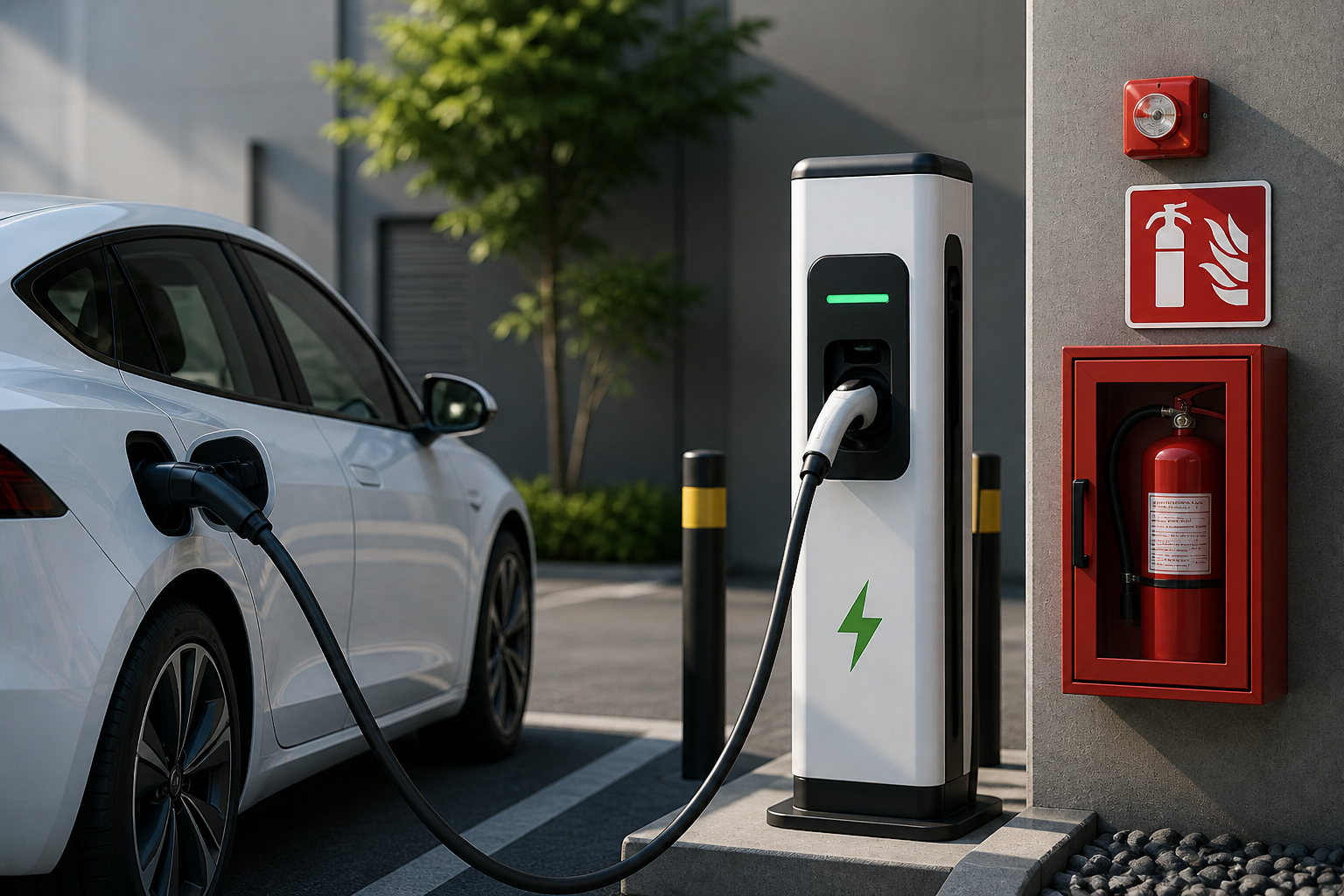
EV charging is quickly becoming part of everyday infrastructure across the UK. From commercial car parks to residential developments, more sites are adapting to support electric vehicles. But while installation and capacity tend to lead the conversation, fire safety planning is evolving just as rapidly behind the scenes.
For businesses, landlords, and facilities managers, EV charging introduces risks that don’t always fit neatly into traditional fire strategies.
A Different Kind of Fire Risk
EV systems rely on high-voltage equipment and lithium-ion batteries. In the event of a fire, the behaviour can differ from what most fire strategies are designed around.
These incidents may:
- Burn at higher temperatures
- Continue for longer periods
- Reignite after initial suppression
Guidance from the National Fire Chiefs Council highlights the growing risks linked to lithium-ion batteries and wider energy technologies, particularly as adoption increases.
Fire chiefs have also warned that safety standards are still catching up with the pace of lithium-ion battery use.
This doesn’t suggest EV charging is unsafe, but it does reinforce the need for fire safety strategies to evolve alongside it.
Placement and Layout Are Critical
Where charging points are installed has a direct impact on fire risk. Enclosed or underground car parks, as well as areas close to entrances and escape routes, require careful planning.
Poor placement can make evacuation more difficult and limit access for emergency services. That’s why EV charging should be considered as part of a wider fire strategy, not treated as a standalone upgrade.
As buildings change, fire strategies need to be reviewed and adjusted to reflect new layouts and risks.
Fire Risk Assessments Need Updating
Introducing EV charging infrastructure isn’t just a physical change – it also affects compliance. Fire risk assessments should always reflect the current use of a building.
That includes considering:
- Electrical load and potential faults
- Charger positioning and cable routing
- Interaction with existing fire protection systems
If your site is evolving, your documentation should too. Highland’s insights into fire risk assessments explain how UK businesses can keep assessments aligned with real-world changes and ongoing compliance requirements.
For reference, UK government guidance on workplace fire safety responsibilities can be found here: https://www.gov.uk/workplace-fire-safety-your-responsibilities
Electrical Systems and Fire Containment
EV charging can place additional demand on existing electrical systems. Without proper design, this can increase the risk of faults or overheating.
Working with specialists during EV charger installation helps ensure systems are designed with both performance and safety in mind. Our EV charger installation service outlines how this can be approached in practice.
At the same time, passive fire protection measures help limit the spread of fire if an incident occurs. This is especially important where new cabling passes through walls, floors, or compartments.
Our fire-stopping service supports this by maintaining compartmentation and protecting key areas of a building.
Detection and Monitoring
Early detection is essential when dealing with evolving risks. In some environments, particularly open or semi-enclosed car parks, traditional systems may not provide full coverage.
More sites are now adopting:
- Enhanced fire detection systems
- Thermal monitoring in higher-risk zones
- Integrated fire and security solutions
Our fire security services show how detection and monitoring can be combined into a single, coordinated system.
For more technical detail, the IET’s Wiring Matters article explores EV charging fire safety considerations in depth, including installation risks and system design.
Planning Beyond Initial Installation
EV infrastructure rarely stays static. What begins as a small number of charging points often expands over time. Without forward planning, this can lead to repeated upgrades – and repeated disruption to fire safety measures.
Designing systems with future capacity in mind helps maintain consistency across both electrical and fire protection strategies. It also reduces the risk of gaps forming as infrastructure evolves.
Our blog on planning electrical capacity for EV expansion highlights how early decisions can influence long-term safety and performance.
A More Integrated Approach to Fire Safety
EV charging is no longer an add-on. It’s becoming part of the core infrastructure of modern buildings. As that shift continues, fire safety planning needs to become more integrated – bringing together electrical design, passive protection, and detection systems into a single approach.
Taking action early makes it easier to manage risk as demand grows and standards continue to develop.
Need Support with EV Charging and Fire Safety?
If you’re planning EV charging installation or reviewing your current setup, it’s worth making sure your fire safety strategy keeps pace.
We support businesses across the UK with EV charger installation, fire stopping, and integrated fire security solutions – helping ensure safety is built in from the outset.
Speak to the team today to discuss your project and make sure your site is prepared for safe, compliant EV adoption.